AI STRATEGY
Your competitors can use the same AI tools. Where does your advantage come from?
See how business knowledge, reliable data and connected systems support better work, with a fictional distributor example and six practical starting steps.

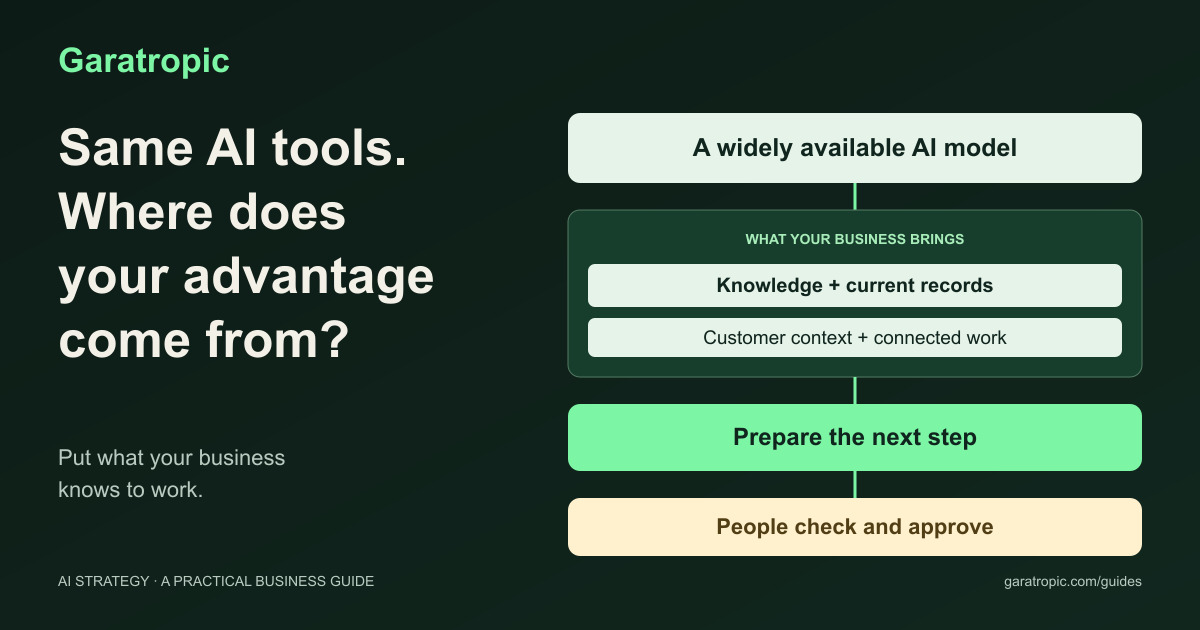
Why do customers choose your business? Perhaps your team recommends the right product, remembers their requirements or gives delivery dates they can depend on.
Now consider what it takes to keep that promise. A salesperson searches old messages. Someone checks which price list applies. An experienced colleague explains an exception. The customer waits while the team pieces the answer together.
AI could help with that work. But your competitors can buy access to many of the same models. A subscription alone gives customers little reason to choose you.
Your advantage depends on how well you combine AI with your business knowledge, customer understanding and ability to deliver.
Choosing an AI model for your business means matching its capabilities to the work. Making it useful also depends on the knowledge, records and working practices around it.
How can AI give your business a competitive advantage?
AI can help your business compete when it makes a customer promise easier to keep: accurate quotations, useful recommendations or dependable follow-up. Start by connecting relevant business knowledge and current records to one job, then measure whether the improvement helps your team deliver.
- Start with a customer promise or business problem worth improving.
- Make the relevant knowledge and records dependable enough for that job.
- Give AI the facts, connections and limits needed for the particular request.
- Help staff check the work, handle exceptions and keep responsibility.
- Learn from reviewed corrections and customer outcomes.
- Measure completed work and total effort before claiming an advantage.
These are capabilities to develop. None guarantees that customers will prefer your business or that a competitor cannot catch up.
Expensive to build does not mean expensive to access
Training leading AI models requires substantial investment. Businesses can buy access to an existing model without financing its development. Usage charges can add up across many requests or several steps, alongside setup, connections and staff review.
Stanford's 2025 AI Index reported that the cost of using a model at GPT-3.5-level benchmark performance fell more than 280-fold between November 2022 and October 2024. This is a historical model-usage comparison, not a measure of total business costs or a claim that every AI service became equally cheap. Read Stanford's report.
Access is also uneven: budgets, account features and available models differ. Model choice still matters. Yet a tool that several businesses can purchase is a weak basis for assuming a lasting lead.
Research on the Productivity J-Curve explains why broad technologies such as AI need accompanying investment in processes, skills and organisational change. Benefits may take time to appear. The research does not promise that an unsuccessful project will eventually pay off.
The management question is what must change in everyday work for the purchase to become useful.
Two distributors, the same model, different preparation
Imagine two fictional distributors using the same AI model. Each receives this repeat-order enquiry:
“Please quote for six cartons of the same cooking oil as last time. Can you deliver on Friday?”
At the first distributor, the salesperson opens a chat tool. They search previous messages, ask accounts which customer record is correct and check a stock spreadsheet. The model can polish a reply, but staff still assemble the facts.
At the second, an authorised workflow finds the customer's previous order, approved price and current stock record. It brings those sources together and prepares a quotation for review. A person checks the order details and confirms delivery arrangements before making a commitment.
The second setup required work: matching records, choosing authoritative sources, connecting tools and agreeing who checks what. Whether it saves effort must be measured.
The same model still needs the business facts
“Six cartons of the same cooking oil as last time. Delivery on Friday?”
Assemble the answer each time
- Search messages for the previous order.
- Ask which customer and price records apply.
- Check stock and delivery with colleagues.
- Supply the facts so AI can draft a reply.
Staff review the draft and carry the details into the order system.
Bring relevant facts to the request
- Match the customer to the previous order.
- Retrieve the applicable price and current stock.
- Show sources, uncertainty and missing checks.
- Prepare a quotation for staff review.
A person confirms delivery and approves the next step.
Now let the stock connection fail. The second system should show that availability could not be checked and give someone responsibility for confirming it. Yesterday's figure must not quietly become today's delivery promise.
If the latest relevant order cannot be identified, or more than one product fits the request, ask the customer to clarify “same as last time”. A dependable process makes uncertainty visible even when that means asking a question.
Six capabilities that support useful business AI
| Capability | What it means in everyday work | What it could improve |
|---|---|---|
| Business knowledge | Approved procedures and lessons from experienced staff | Consistent handling of familiar problems |
| Reliable records | Current prices, clear product details and matched customer histories | Less searching and correction |
| Useful context | Business background, customer preferences and the current request | Answers that address the actual need |
| Connected systems | Information moves between the tools where work happens | Fewer repeated entries and missed handovers |
| Staff judgement | People can check, question and override assistance | Better handling of exceptions |
| Learning from results | Reviewed outcomes improve records and working practices | Fewer repeated mistakes |
1. Make experienced staff's knowledge easier to use
A senior salesperson may know which question prevents an unsuitable order. A dispatcher may know why a particular delivery needs extra confirmation. Ask them to explain recent cases, including what changed the decision.
Turn useful lessons into reviewed guidance with an owner and date. Preserve the reason for an exception and who can approve it. Some judgement will still require experience or a conversation with a colleague.
A published study of 5,172 customer-support agents at one business-software company found a 15% average increase in issues resolved per hour with AI assistance. Less experienced workers benefited more; the strongest agents saw limited speed gains and some decline in conversation quality. People could edit or ignore suggestions. Read the 2025 study.
That supports testing how assistance spreads useful practices. It does not establish a 15% gain for your business. Our knowledge-management guide explores the work of keeping guidance useful.
2. Check whether your business data is ready for AI
For repeat quotations, check whether the team can identify the customer, product, pack size, applicable price and previous order. Agree which source wins when records disagree, and who corrects it.
You can start with one product range and a limited set of approved records. Preparing that task does not require cleaning every historical file.
Adding new information without managing old versions can make answers less dependable. A 2025 research benchmark found that outdated material could harm answers even when current information was also available. This was a test of AI systems, not a measured business failure rate. Read the HoH study.
“Ready for AI” should mean suitable for a defined use, with known gaps and someone responsible for maintaining it.
3. Supply the context behind the request
Context is the relevant background needed to understand the task. It includes what your business does, who it serves, its history and the reasons behind current working practices. It also includes this customer's history, preferences, earlier conversations and the current request.
A context layer means the arrangements that give AI the right business information for the task. That can include approved instructions, selected records, relevant conversation history and access to tools. It is not a single product every business must buy.
For the distributor, an earlier delivery problem may explain why staff now confirm a delivery slot before promising a date. A customer's previous order helps explain what they mean by “the same one”. Both are useful context, serving different purposes.
Now add a detail from an earlier conversation. The customer said:
“Please don't suggest Brand A again. The bottle caps leaked in my kitchen.”
Their last order was Brand B. If Brand B is unavailable today, a stock list alone might lead an agent to suggest Brand A. Bringing the customer's earlier preference into the current task gives it a reason to check other options or ask before proposing a substitute.
That detail can be easy for a person to miss across many customers and staff handovers. An agent with a well-designed memory can retrieve it when relevant, helping the customer continue without explaining the same preference again. It should preserve that the customer reported a problem, rather than turn the message into a verified claim about every bottle of that brand.
Context is more than the latest message
“Six cartons of the same cooking oil as last time. Delivery on Friday?”
Products and customers
Supplies cooking oil to restaurants. Quotes identify the brand, bottle size and number of cartons.
Why the process changed
Earlier delivery problems led to a rule: confirm a delivery slot before promising a date.
What “same as last time” means
The matched customer's last order was Brand B, in cartons of 5 L bottles.
What is available today
Stock checked for this enquiry: Brand B is unavailable. Brand A is in stock. Friday delivery is unconfirmed.
A detail from an earlier conversation
Customer message · 12 September 2026
“Please don't suggest Brand A again. The bottle caps leaked in my kitchen.”
A reported experience and preference. Keep the source and date; check for newer instructions from the customer.
A substitute needs more than a stock check
The customer wants Brand B. It is unavailable, and they previously asked to avoid Brand A. Check other options, ask before substituting and leave the delivery commitment for staff to confirm.
Continue the conversation
“Brand B is currently unavailable. You previously mentioned a problem with Brand A's bottle caps. Would you like me to check other options? I'll also confirm whether Friday delivery is possible.”
Confirm before committing
Review the sources and latest messages, check alternatives and delivery, then approve the reply. The customer's next answer may update the preference.
Here, memory means selected information stored by the application and brought back when it is useful. The original message and date should be available for checking. A newer request can change the preference; “I avoided it last year” does not establish what the customer wants today. Staff need a way to correct or remove an inaccurate note, and access should stay with the right customer and authorised team.
Remembering across conversations is a capability to test. LongMemEval, a research benchmark, examines recall across conversations, changing information and knowing when an answer is missing. It does not establish that a particular agent will remember every preference. The agent-memory guide explains the difference between the current conversation, stored history and selected facts.
Anthropic's context-engineering guidance describes selecting and maintaining relevant information for a model. It is engineering guidance from a provider, rather than independent evidence of competitive advantage.
A small task may begin with a person supplying approved information. A repeated task needing live stock and order history may justify connections. Uploading files does not by itself provide current records, enforce permissions or retrain the model.
4. Connect preparation to the next piece of work
A draft quotation is useful only if someone can review it and carry the agreed details forward. Otherwise, staff may copy the answer into another system and repeat the checks.
Look at the handover: who reviews, where the approved order belongs and what happens when a connection fails. Reading stock, preparing an order and committing to delivery need different permissions. Enforce those limits in the software.
Use existing software features where they fit. Some repeated copying needs ordinary automation; AI becomes useful when the task involves interpreting varied messages or preparing work from several sources. The integration guide follows those connections in more detail.
5. Give people time and authority to check
Staff need to see the original request, supporting records and missing facts. An AI interface that goes beyond chat can put that context beside the draft, with clear ways to edit, approve or hand the case to a colleague. Staff also need a clear route to the person who can resolve an exception.
Include the people doing the work when designing the process. Ask whether a draft helps or simply creates another thing to repair. Keep a manual route when the tool is unavailable.
Customer relationships remain part of delivery. AI can help a colleague remember an earlier commitment. The business still has to honour it, explain a delay or negotiate a change.
6. Turn reviewed outcomes into improvements
Suppose staff repeatedly correct the same pack size. Check whether the catalogue is ambiguous, customer history is mismatched or the assistant missed a clear instruction. Fix the cause and test that case again.
Record what was corrected and why. A responsible person can approve changes to guidance, records or the workflow. Save representative cases so a later model or software update can be checked against them.
Reviewing corrections does not automatically retrain the underlying model. It can improve the information and process around it. Training a model further is a separate decision requiring suitable examples and a business case.
What would be harder for a competitor to copy?
A competitor can subscribe to the same service, buy similar software and improve its records. Those foundations are valuable, but may become normal expectations in your market.
Ask what the combined system helps your business do particularly well. Perhaps staff can use years of reviewed installation lessons, understand repeat customers' requirements and coordinate reliably with trusted suppliers. The value comes from putting that experience to work for customers.
Private data is useful only when it helps a worthwhile decision. A large archive of irrelevant messages may add little. A smaller, maintained record of recurring problems and effective responses may be more useful.
My interpretation of the research is that advantage can develop through these combinations and continued improvement. It remains a business judgement. Faster quotations will mean little if the product is unsuitable, the price is uncompetitive or delivery is unreliable.
How to start building your business's AI advantage
The OECD's 2026 D4SME survey found uneven integration of AI into operations, with time, maintenance costs and skills among the barriers. Its sample of more than 2,000 SMEs in 12 OECD countries was non-representative. It identifies practical obstacles rather than describing every small business. Read the report.
Start with work small enough to maintain:
- Choose one customer promise. For example, prepare accurate repeat-order quotations with a delivery date that someone has checked. Define what an acceptable result includes.
- Follow the current work. Watch where staff wait, search, retype or ask for help. Record the current turnaround and checking effort on comparable requests.
- Gather the necessary knowledge and records. Identify approved sources, useful staff experience and gaps. Use only information the team and proposed service are permitted to access.
- Assign owners. Decide who maintains prices and guidance, resolves conflicts, reviews drafts and handles failed connections. Include these responsibilities in the operating cost.
- Test a narrow assisted workflow. Keep staff approval. Try an ambiguous product, conflicting prices, unavailable stock information and a preference from an earlier conversation. Then change that preference and check that the current preference replaces the old one. Check that one customer's memory is not shown to another and restricted records stay restricted.
- Compare the whole result. Measure quotation accuracy, time to a useful answer, corrections, missed commitments and total cost, including setup, review and maintenance. Ask staff and customers what improved.
To see what preparation contributes, compare drafts using the same model with the old preparation method and the reviewed information. Keep the task and review standard consistent. A small comparison can guide the next step; it cannot prove that rare mistakes will never happen.
Time released is useful capacity, but becomes cash savings only when expenditure actually falls. The AI return guide explains that distinction. Expand when quality and total effort justify it; change or stop the approach when they do not.
Put what your business knows to work
Return to the repeat customer. The useful improvement is a team that can recognise the request, find dependable facts, prepare the next step and keep its commitments.
At Garatropic, we help examine that process, organise the relevant information, connect existing tools and test whether the result helps. Based in Nairobi, Kenya, we work with businesses worldwide. The starting point can be one awkward handover or repeated check.
Research and helpful links
-
Stanford AI Index 2025: historical model-access cost comparison
-
The Productivity J-Curve: published 2021 research on complementary investment
-
Generative AI at Work: published 2025 customer-support study
-
HoH: 2025 benchmark on outdated information in AI knowledge sources
-
Anthropic: effective context engineering for AI agents
-
LongMemEval: research on memory across conversations and updated information
-
OECD: Empowering SMEs in the Age of AI, 2026
Sources checked on 25 October 2026. The distributors, enquiry and diagrams are fictional teaching examples, not client work, measured results or a live product. The argument about competitive advantage is the author's interpretation; the proposed workflow needs testing in the business where it will be used.