AI STRATEGY
Which AI model does your business actually need?
Choose a model around the work, understand what comes with an AI product, and decide when greater capability or running your own model is worth the cost.

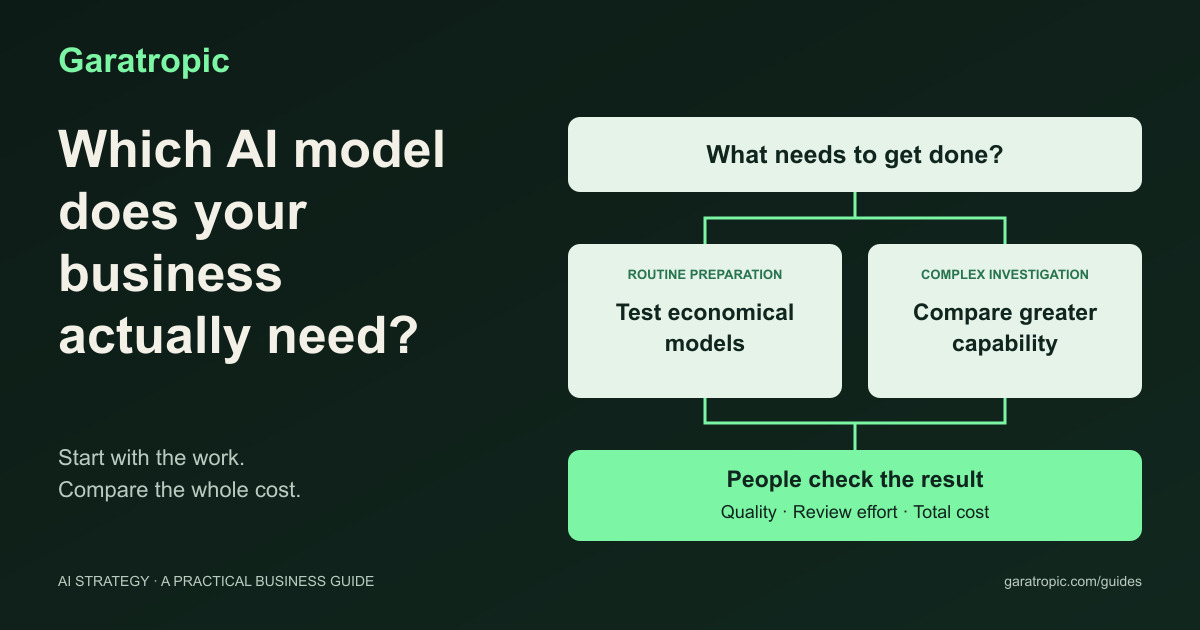
Your sales team wants help with the messages that arrive every morning. Some ask for a price list. Others contain an order to copy into the system. A few describe a delivery problem that needs investigation.
Someone suggests using the latest, most capable AI model for everything. Someone else says a cheaper model will do. A third person wants the whole thing running on the office server so customer information stays inside the business.
These suggestions answer different questions. How difficult is the work? Are you buying a finished product or a component? Where will the information go? Who will keep the service working?
The useful question is which setup helps your team finish the work dependably, at a cost and level of responsibility your business can support.
The distributor below is fictional. Snapsheet, introduced later, is a real Garatropic product. Together they show the difference between choosing a setup and measuring what a focused task costs.
The short answer
- Test economical models on clear, repeated tasks before paying for greater capability.
- Compare useful results, checking time and total cost.
- Separate the model from its product, connections and permissions.
- Compare providers and combine models where different stages need different strengths.
- Treat capability, downloadable availability and hosting as separate choices.
- Self-host when there is a clear reason and someone can own the ongoing work.
Start with four pieces of work
Consider four requests from customers and colleagues:
“Please send your current cooking oil price list.”
“Six cartons of the same 5 L brand as last time, please.”
“Make this reply friendlier without changing the delivery date.”
“You charged us twice, and neither delivery matches what we agreed.”
Sorting the price-list request into a sales queue and rewriting an approved reply are narrow tasks. The repeat order needs customer history: “same as last time” does not identify a product by itself. The payment dispute may require invoices, payment and delivery records, and a person authorised to resolve it.
A model that handles the narrow tasks may struggle with the investigation. Greater capability still cannot establish what was paid without the right records. The WhatsApp business guide follows those connections in more detail.
“Use AI in sales” is too broad to test. “Extract the product and quantity, flag missing details and prepare a draft for staff” gives the team something concrete to assess.
ChatGPT, GPT and an agent are different parts of the picture
A model is the component that interprets the information supplied to it and generates a response. GPT is an OpenAI model family; Gemini is a Google model family. Different models support different kinds of input, such as text, pictures or audio.
ChatGPT is a product people use. It adds an interface and features such as file handling, search and connected tools around models. The Gemini app is also a product; Gemini model access through Google's developer service is a different offering.
An API is a connection that lets one piece of software use another service. A model API could power the distributor's enquiry software. Someone still needs to supply the inbox, customer records, order connection and review screen.
An agent is a system that can pursue a goal through several steps. It combines a model with instructions, tools, progress tracking and permissions. The surrounding software carries out permitted actions and returns results so the model can decide what to try next.
The product, the model and the process
An interface around models
The product adds the screen, features and access available to your account.
A model working with…
- Instructions
- Connected tools
- Progress tracking
- Permissions
An agent investigating a delivery might find the order, check dispatch records, compare the customer's messages and prepare a brief. Staff would still approve a refund. A fixed workflow can handle a known sequence without giving a model that much freedom. The plain-English agent guide explains when the extra flexibility is useful.
The models available inside a product can differ from those offered to developers. Check the product's features and your account's access before assuming a model API and a chat subscription provide the same experience. OpenAI's model-availability guide.
What do the model tiers mean?
Providers commonly offer a range that trades capability against price and speed. The following are useful descriptions, not an industry standard:
| Broad tier | Work worth testing | Business trade-off |
|---|---|---|
| Economical models | Classifying enquiries, extracting clear details, short summaries and controlled drafts | Lower usage cost; check performance on ambiguity and exceptions |
| Balanced everyday models | More varied writing, comparisons and connected work with several requirements | A middle option to test when the economical model needs too much correction |
| Flagship models | Difficult analysis, conflicting evidence and demanding work across many steps | Greater capability may justify extra cost and waiting time |
For example, OpenAI positions GPT-6 Luna for focused, high-volume work, GPT-6.1 Sol as balancing intelligence and cost, and GPT-6 Astra for demanding reasoning and coding. These are provider descriptions, not fixed boundaries between tasks. OpenAI model catalogue.
“Third-tier” can sound like an unwanted compromise. For repeated work with a clear answer, an economical model that consistently meets the standard may be exactly what the business needs.
Price tier is not physical size
A physically smaller model has fewer learned numerical settings, called parameters. Downloadable models often publish parameter counts because they affect the equipment needed to run them. Hosted providers do not always disclose comparable size information.
Names such as Luna, Flash-Lite, Mini and Pro describe a provider's offerings. They do not establish a universal size or capability ranking. An economical hosted model is not necessarily something you can download or run on an office computer.
Reasoning effort is another setting: how much processing a model uses to work through a response. Increasing it can improve some difficult results while adding time and usage. It does not turn one model into another. Start with the normal setting and test changes against the actual task. OpenAI's explanation.
Why economical models deserve a serious trial
The distributor could begin with sorting enquiries, extracting stated product details, summarising conversations and preparing drafts from an approved price list. The job is defined and the relevant facts are supplied. It does not require the model to invent a pricing policy or decide how much credit to extend. I would include Luna, Flash-Lite and Haiku in this comparison.
Give it examples of acceptable results and missing information. An unclear product should be flagged unless approved customer history resolves it. The software can check quantities and product codes. A neatly formatted answer can still contain the wrong facts.
Keep exact calculations in a calculator or business system. If the current software can copy a known field or apply a fixed rule reliably, adding a model may provide little benefit.
A real example: reading receipts with Snapsheet
Snapsheet, our receipt-to-data product, is a practical example. It reads receipt photos or PDFs and prepares fields such as the merchant, date, totals, VAT and line items for a person to review and export.
Our AI/model cost for reading and extracting a receipt is less than KSh 1—below about US$0.008, or eight-tenths of a US cent. Hosting, storage, maintenance and staff review are separate; repeated attempts can add processing cost. This is our extraction cost, not a customer price or full operating cost. The dollar equivalent uses CBK's KSh 129.81 per US$1 for 15 October 2026. CBK source.
Preparing defined receipt fields does not automatically need the same model as a difficult software project. The result still needs checking against the source: low extraction cost would mean little if staff had to repair every record.
What the research supports—and what it does not
A May 2024 Microsoft study examined one internal cloud supply-chain application. Specially trained smaller models outperformed the larger models, which received examples in their requests instead of additional training. This was a comparison of different preparation methods as well as models. Read the original paper.
That supports specialisation in a defined setting, not a claim that an untouched small model beats today's flagships. Its running-cost estimates also assumed high use of rented equipment; an idle office server would have different economics.
A 14 October 2026 preprint adds a caution: across 15 downloadable models and two synthetic tasks, the smallest option per call was not always the most efficient per completed task. The limited pilot used one machine and 15 runs per model and task. It supports counting failed attempts alongside completed work, rather than ranking Luna, Flash-Lite or Argon for a business.
Specialised training, called fine-tuning, may help later, but needs suitable examples, maintenance and a business case. Uploading a price list for reference is different from training a model.
When does a more capable model earn its place?
Return to the disputed delivery. The customer says two charges were taken. Accounts shows an invoice and a credit note. Dispatch records show a partial shipment. A previous email mentions a replacement.
This may require comparing documents, reconstructing events and identifying contradictions without quietly resolving them by guesswork. A more capable model is worth testing here. It should prepare a sourced explanation of what is established, what conflicts and what a person must check next.
Other reasons to compare a stronger model include complex instructions that the economical model keeps missing, unfamiliar requests, and investigations where each step depends on the previous one. Before upgrading, check whether the real problem is missing records, an unclear task or a failed connection. More capability cannot repair a payment system it cannot reach.
Where Gemini 4 Argon fits
Google announced Gemini 4 Argon's wider availability on 13 October 2026. Its documentation lists it as stable and positions it for demanding reasoning and complex work across multiple steps. This is a current example of the flagship category, with a different purpose from Flash-Lite's economical execution. Google announcement, model documentation.
Test Argon on difficult cases for better evidence, fewer material mistakes or less review work. A new release alone does not justify replacing a model already doing the job well. Missing facts or financial authority may still require a person; a model's confidence is not proof that its answer is correct.
Compare providers as well as tiers
I understand the attention given to Opus, Fable, Astra and Sol: demanding projects can benefit from their capabilities. But everyday work may need less. Sol itself illustrates the middle of a provider's range; it should not be treated as identical to a flagship simply because both attract attention.
Here are my preferences and starting points for evaluation. They are personal judgements, not results from a comparative test for this article.
Gemini Flash and Flash-Lite: a strong starting point for document work. I particularly like Gemini 3.8 Flash and Gemini 3.5 Flash-Lite for their combination of capability and usage cost. Their PDF processing interprets pictures, charts and tables alongside text. The distributor could find pack sizes in an illustrated catalogue and check the source pages. Large files still have processing limits, and poor scans or complicated tables need careful checking. Flash documentation, Flash-Lite documentation, PDF processing.
Their input range also appeals to me: text, pictures, audio, video and PDFs. The same family could handle a catalogue, a customer's voice note or a damaged-delivery video. That includes audio and video support beyond the text-and-image inputs listed for the particular Luna, Astra and Claude models here. Other providers can process PDFs too: OpenAI supplies extracted text and page images to compatible vision models. Compare exact model and product support. Gemini inputs, Claude inputs, Astra inputs, OpenAI PDF handling.
Gemini image models: my personal first choice for generating pictures. Nano Banana 2.1 and Nano Banana 2 Lite are examples for campaign visuals and design ideas. They are distinct from regular Flash and Flash-Lite, which accept images but return text. Evaluate the generated result against the actual brief, product details and brand requirements. Google's image-model guide.
GPT-6 Luna: one of my strongest value choices for everyday work. I regard Luna as a peer to Flash-Lite and potentially the better choice when capability and price are considered together. It supports image input as well as text. The point is useful capability at a very low price; it belongs early in the comparison. Luna documentation.
Claude Haiku 5.5: worth reconsidering at its new price. I previously found Haiku harder to justify on price for routine work. The version released on 7 October 2026 changes that comparison: its starting rates match Luna's quoted standard rates. It belongs alongside Luna and Flash-Lite in a trial, with the request-length limits shown below. Haiku documentation.
Opus, Fable and Astra: candidates for demanding technical work. I would shortlist Claude Opus 5.5, Claude Fable 5.1 and GPT-6 Astra for complex coding, difficult analysis and sustained work across many steps. They could help prepare code to investigate a stock-planning problem; connected software runs the calculations, and people check the result. Their providers position them for these tasks. Opus, Fable, Astra.
You can combine models in one workflow
You do not have to choose one model for everything. A setup worth testing could use Luna to sort enquiries, Flash-Lite to read illustrated catalogues, and a more capable model to prepare the difficult delivery investigation. The models can come from the same provider or different providers. Staff still approve the outcome.
Send each job down a suitable path
“Please send your price list.”
Sort the enquiry and prepare a reply from the approved price list.
“Which pack sizes are shown?”
Read the relevant text and pictures, keeping the source pages.
“These charges do not match.”
Compare the available records and prepare an investigation brief.
Use clear rules for which stage goes to which model, preserve the source records between stages, and measure the combined result. Each additional model should justify its connection, monitoring and data-handling costs. An outage fallback also needs approval in advance; it should only send information to permitted providers.
Services that give access to several models
You can buy model access directly or through a platform offering a catalogue of models. These services can bring several options into one technical setup:
| Service | What it provides |
|---|---|
| Amazon Bedrock on AWS | Managed access to models from Amazon and other suppliers. |
| Google Cloud's Gemini Enterprise Agent Platform, the evolution of Vertex AI | Google and partner models through its Model Garden, alongside tools for building and operating applications. |
| Microsoft Foundry on Azure, previously Azure AI Foundry | A model catalogue and tools for building, evaluating and managing AI applications and agents. |
| OpenRouter | A common API for accessing models across providers, with options for selecting providers and routing requests. |
The model and the access service are separate choices. Check the exact model version, supported features, processing location and price on the service you will use. A common connection does not give every model identical capabilities or terms. OpenRouter, for example, documents provider-selection and data-policy settings as well as platform fees. Routing controls, fees.
Open models, open weights and open source
Weights are the learned model files used to generate responses. When a provider releases them, a team can potentially download and run the model, subject to its licence and the necessary software and equipment.
“Open model” is a broad label. Ask what is actually available and what you are permitted to do with it.
| Description | What it tells a buyer | What still needs checking |
|---|---|---|
| Proprietary hosted model | Access is provided as a service under the supplier's terms | Data handling, supported uses, availability and exit options |
| Open-weight or downloadable model | The learned files are available under stated terms | Commercial use, modification, redistribution and operating requirements |
| Open-source AI | A claim about freedoms and the materials available to study and modify the system | Which definition is being used and whether the release meets it |
The Open Source Initiative's definition includes freedoms to use, study, modify and share, together with code, parameters and sufficient training-data information to support modification. Downloadable weights alone do not establish that the complete AI system meets that definition. Read the definition.
For concrete examples, OpenAI provides gpt-oss-20b as an open-weight model under Apache 2.0. Google also releases Gemma 4 weights under Apache 2.0. Earlier Gemma models use different terms, so the exact version matters. These examples do not mean GPT-6 Luna or Gemini 4 Argon can be downloaded. gpt-oss documentation, gpt-oss licence, Gemma terms and version distinction, Gemma 4 licence.
A permissive licence does not provide a working customer-service product, maintenance or a guarantee about outputs. Ask whoever proposes the deployment to identify the model, licence, included components and support owner in writing.
Where should the model run?
An open-weight model can run through a hosting provider. A business can also operate it on rented cloud machines or its own equipment. Self-hosted means your team or appointed operator takes responsibility for running it; on premises means it runs at your own site. They are not synonyms.
| Arrangement | What the business gets | Responsibility to budget for |
|---|---|---|
| Ready-made hosted product | An interface and a defined set of features | Product fit, accounts, permissions, terms and staff use |
| Provider's model API | Model access inside your own software | Integration, records, review screens, controls and outages |
| Self-hosted on rented cloud machines | Control over an operated model deployment | Cloud capacity, security, updates, monitoring and support |
| Company premises or devices | Local model processing where the setup supports it | Suitable equipment, power, access, backups and ongoing operation |
A chat app installed on a laptop may still send requests to a provider. Likewise, hosting your agent software internally does not make the model local. Ask where the model processes the request, then map the documents, tools, logs and backups around it.
Where does the model process your information?
App here. Model elsewhere.
Your team runs a remote model.
Model processing stays on site.
When self-hosting is worth investigating
There may be a requirement to process selected information within a controlled environment. A warehouse may need a bounded task to keep working without internet access. A business may have sustained usage, suitable equipment and an experienced team that can operate a model economically. These are concrete reasons to investigate.
They need testing. Offline model processing does not make an online order database available offline. Sensitive information can still leave through search tools, support access, logs or backups. An on-premises machine also needs protection from unauthorised colleagues and compromised accounts.
Google's Gemma hardware guidance illustrates why “fits on this computer” is only a starting point: model files need memory, and longer requests require additional working memory. Running one demonstration does not establish that the same machine can serve a busy team promptly.
Ask for a trial using expected document lengths and simultaneous users. A GPU, a processor often used for AI computation, may be part of the equipment budget. Include unused capacity, power or cloud rental, monitoring, updates, repairs and recovery. You can self-host an existing trained model without training a new one.
NVIDIA's 16 October 2026 guidance on open-weight model risk makes the responsibility clear: testing the model alone cannot establish the safety of the connected system. Its permissions, tools and operating software matter too.
For the distributor's first pilot, I would compare suitable hosted options before buying hardware, unless a specific constraint rules them out.
Hosted does not answer every privacy question
Ask whether information is used for training, what is stored, who can access it and where processing takes place. These are separate questions. OpenAI says API data is not used for training unless customers opt in, while its documentation also describes retention and feature-specific storage. “Not used for training” does not mean “never retained”. OpenAI data controls.
Google's Gemini API terms distinguish paid and unpaid services, including regional differences. They warn against submitting sensitive information to unpaid services under the general unpaid-service terms. Check the exact account and service rather than transferring assumptions from a consumer app or a free experiment. Gemini API terms.
Compare the cost of completed work
Model APIs commonly charge by tokens: small units of the material processed and generated. Input includes instructions and supplied information. Billable output can include reasoning as well as the visible answer. Models can count the same material differently, so a token price is not a price per document or customer enquiry.
Luna, Flash-Lite and Haiku side by side
These are standard paid API rates in US dollars per million tokens, checked on 19 October 2026. They use the model developers' own APIs; another access platform may have different rates or fees. They exclude tools, tax and discounts for reusing previously processed input or processing work in batches. They are not employee subscription prices. Sources: OpenAI, Google, Anthropic.
| Model | Input | Output | Request length for these rates | Introductory period | Scheduled future price |
|---|---|---|---|---|---|
| GPT-6 Luna | $0.10 | $0.50 | Up to 272,000 input tokens | Not labelled introductory | No later rate listed |
| Gemini 3.5 Flash-Lite | $0.30 | $2.50 | Up to 1,048,576 input tokens | Not labelled introductory | No later rate listed |
| Claude Haiku 5.5 | $0.10 | $0.50 | Up to 100,000 input tokens | Not labelled introductory | No later rate listed |
For these three models, the pricing sources checked do not publish a dated introductory offer or scheduled later rate. That is not a promise that prices will stay unchanged.
Longer requests have different current prices. Above 272,000 input tokens, Luna lists $0.20 input and $0.75 output per million tokens. Above 100,000 input tokens, Haiku lists $0.50 input and $2.50 output. The higher rates apply to the whole qualifying request, not just the portion above the threshold. These are request-length surcharges, not future price increases.
Luna and Haiku therefore start at matching unit prices, with different limits. For context, Astra's standard input and output rates for requests up to 272,000 input tokens are $10 and $50: one hundred times Luna's rates. That comparison establishes a price difference, not equivalent results.
Where introductory pricing does apply
Google publishes dated prices for two other models discussed here. The amounts below are input / output dollars per million tokens, using standard paid processing. Google pricing.
| Model | Introductory input / output | Available through | Announced later input / output | Starts |
|---|---|---|---|---|
| Gemini 3.8 Flash | $0.75 / $3.75 | 31 December 2026 | $1.50 / $7.50 | 1 January 2027 |
| Gemini 4 Argon | $2.00 / $10.00 | 30 November 2026 | $4.00 / $20.00 | 1 December 2026 |
Build the longer-term budget around the announced later price. Image generation has its own charges; these text-output rates do not price a finished campaign image.
A monthly budget for the distributor
Suppose the distributor prepares 10,000 drafts a month, each using 2,000 input tokens and 500 billable output tokens, including charged reasoning. That is 20 million input and five million output tokens. Assume one call per draft, no discounts and no separate tool calls.
At identical billable usage, model cost would be $4.50 for Luna or Haiku, $18.50 for Flash-Lite, and $90 for Argon at its introductory price, rising to $180 at its announced December rates. For example, Flash-Lite is 20 × $0.30 plus 5 × $2.50.
These are invented usage assumptions, not measured workloads or a claim that each model needs the same processing to produce an acceptable draft. Add 10% of identical usage for retries and the respective amounts become $4.95, $20.35, $99 and $198. An agent that searches, checks and revises may make several calls. With a mixed setup, count each model's calls at its own rate; use actual billing records when budgeting a pilot.
Now add invented monthly amounts: $150 for the inbox, $200 for integration upkeep and $50 for connected tools. One minute of staff review per draft at an assumed staff cost of $15 an hour adds $2,500. The resulting totals, including retries, are $2,904.95 for Luna or Haiku, $2,920.35 for Flash-Lite, or $2,999 for Argon at its introductory price, before setup and tax.
The budget around the model calls
If a stronger model reduced review by 15 seconds per draft without reducing quality, that would represent about 41.7 hours, valued at $625 under the same labour assumption. If it made no useful difference, its extra cost would buy little. Staff time freed is not automatically cash saved. Compare either option with today's process; the AI return guide explains that business case.
For self-hosting, replace the model-usage line with the full computing and operating cost at actual utilisation, including quiet periods and peak demand. Review, inbox and integration work still need a budget.
A starting method your team can use
If employees simply need occasional writing help, begin with an approved ready-made product that fits your information rules. You may not need a custom agent or a separate model decision yet. If the improvement depends on current business records and repeated preparation, test that connected task deliberately.
Choose one task and write down what a satisfactory result means. For the distributor, it might be: extract stated product details, identify missing information, use only the approved source for prices, and prepare a draft without sending or changing an order.
Build a small, representative collection of past or fictional cases. Include ordinary work and deliberate exceptions: “same as last time”, two plausible products, conflicting prices, a missing record, an unreadable attachment, a sensitive payment question and a failed connection. Use approved or suitably anonymised information.
Compare an economical model with a more capable candidate using the same task, sources and permissions, including another provider where practical. Check input support first: a text-only model cannot directly inspect a damaged-delivery photograph. Record the settings and versions so the comparison can be repeated.
Have the people who do the work assess factual correctness, important omissions, appropriate handover, response time and correction effort. Where practical, hide the model names during review. Check risky cases separately; a high average score can conceal an unacceptable financial mistake. A small pilot cannot prove rare errors will never occur.
Agree the acceptable quality, review burden and cost before selecting a winner. Choose the lowest total-cost option that meets those requirements. It may be the economical model, a stronger model, ordinary automation or a narrower task. Keep sending, payments and other commitments subject to enforced permissions and appropriate human approval. See the permissions guide.
Repeat the checks when the model, sources or workflow change, and keep a manual route for outages. For the distributor, success means less effort preparing dependable replies and a clear owner for difficult cases. Pay for greater capability or take on hosting when that work gives you a reason.
Once you have a suitable model, consider where your business's AI competitive advantage could come from: the knowledge, customer context and connected work that help your team deliver on its promises.
Research and helpful links
- OpenAI model catalogue, GPT-6 Luna documentation, GPT-6 Astra documentation and API pricing
- ChatGPT Work and Codex model availability and reasoning settings
- Gemini 3.5 Flash-Lite documentation
- Gemini 3.8 Flash documentation, PDF processing and image-generation models
- Claude Opus 5.5 documentation and Claude Fable 5.1 documentation
- Claude Haiku 5.5 documentation and Anthropic API pricing
- Gemini 4 Argon: wider-release announcement, 13 October 2026 and model documentation
- Gemini Developer API pricing
- Amazon Bedrock, Google Cloud's platform naming and model services and Microsoft Foundry on Azure
- OpenRouter overview, provider routing and pricing
- Small Language Models for Application Interactions: original May 2024 case study
- When Is Smaller Greener? Right-Sizing Language Models for Agentic AI: 14 October 2026 preprint
- Open Source Initiative: Open Source AI Definition 1.0
- gpt-oss-20b documentation and licence
- Gemma 4 hardware and deployment considerations, Gemma terms and Gemma 4 licence
- NVIDIA: evaluating risk in open-weight models, 16 October 2026
- OpenAI API data controls and Gemini API additional terms
- Snapsheet receipt processing and CBK's 16 October 2026 bulletin for the currency conversion
Sources, model availability, licences and listed prices checked on 19 October 2026. Availability, terms and rates can change. The distributor, draft volumes, budget assumptions and review improvements are fictional planning examples. Snapsheet is a Garatropic product; its extraction-cost figure is our own product information and covers AI/model processing only. The author's model preferences are personal judgements. No comparative model testing was performed for this article; suitability and operating cost must be established in the proposed business workflow.